A 二手机动混凝土泵车 should be evaluated with a maintenance record that connects the exact chassis and pump superstructure to dated service, inspection and repair evidence. Ask for identification numbers, mileage and pump hours, routine-service entries, boom inspection reports, structural repair records, hydraulic work, pumping-system wear-part replacements and chassis maintenance. Then compare that history with a current physical inspection. Missing paperwork does not automatically make a truck unsuitable, but it increases uncertainty and may require broader testing, a repair allowance or different purchase terms. Records are evidence inputs—not a guarantee of future performance.
要点总结
- Match every record to the exact pump serial number and chassis VIN.
- Build one timeline using dates, mileage, pump hours, inspections, repairs and replaced parts.
- Separate routine service, structural inspection and repair documentation; they prove different things.
- Confirm old paperwork against current photos, live tests and a qualified inspection.
- Use evidence gaps to define further checks and contract terms, not to invent a discount.
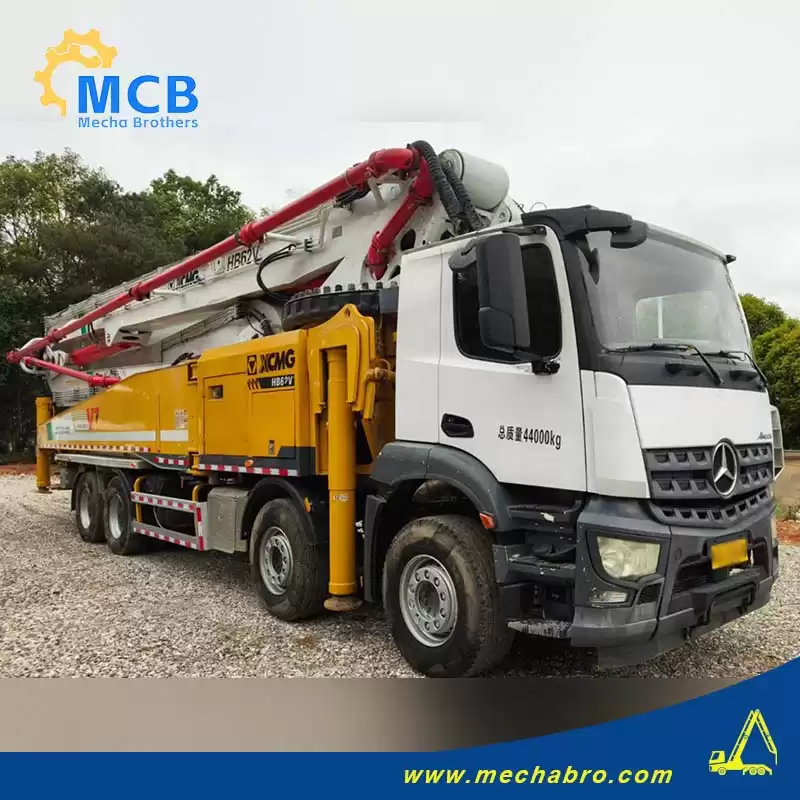
The image above is a Mechabro real-equipment product-catalog photograph linked to product reference 250328P699. It illustrates why a listing and photograph need supporting records. This article does not claim that the photographed truck has a complete maintenance history or is currently available.
Why Maintenance Records Matter When Buying a Used Concrete Pump Truck
A pump truck is not one simple asset. It combines a road chassis, power take-off, hydraulic system, concrete pumping system, placing boom, outriggers, controls and safety devices. Different components may have different operating histories, repair cycles and identifiers. A dashboard mileage reading alone cannot describe pump use, and a pump-hour reading cannot establish the condition of the road carrier.
Good records help a buyer reconstruct what was maintained, inspected or repaired and when. They also expose questions that need investigation. For example, a structural inspection report may confirm the scope examined on a certain date, but it does not prove today’s condition. A parts invoice may confirm that an item was purchased, but not that it was installed correctly on the offered machine. The purchase decision should combine documents with current evidence.
Used Concrete Pump Truck Maintenance Records Checklist
| Record group | Evidence to request | What to verify | Decision affected |
|---|---|---|---|
| Identity baseline | Pump plate, serial number, chassis VIN, engine details, mileage and pump hours | Identifiers agree across the truck, quotation and reports | Confirms which unit the history belongs to |
| Routine service | Dated service log, fluids, filters, lubrication and scheduled checks | Dates and meter readings form a plausible sequence | Shows maintenance discipline and overdue work |
| Boom and support structure | Periodic inspection reports, findings, photographs and repair approvals | Scope covers boom sections, turret, pedestal, outriggers, pins, cylinders and related areas | Defines structural due diligence |
| Pumping system | Records for wear plate, cutting ring, valve, delivery cylinders, hopper and pipeline | Part references and replacement dates match the machine | Supports wear and near-term service planning |
| 液压与控制 | Hose, seal, pump, valve, sensor, remote-control and electrical work | Repeated failures have a documented cause and resolution | Highlights leakage, control and reliability risks |
| Road chassis | Engine, transmission, brakes, steering, suspension, tyres and emissions records | Current road condition and destination rules are checked separately | Affects import, registration and inland operation |
How to Verify the Record Package in Five Steps
1. Tie every document to the offered machine
Start with readable images of the pump plate and chassis VIN. Add the current odometer and pump-hour meter. Review whether invoices, service sheets and inspection reports show the same identifiers. If a report uses only a fleet number or handwritten description, ask how it can be linked to the physical unit.
2. Build a chronological service timeline
Arrange records by date and meter reading. Look for unexplained reversals, long gaps or identical readings repeated across distant dates. Check whether major repairs are followed by testing or acceptance evidence. A gap is not proof of a defect; it is a reason to widen the present-condition inspection.
3. Distinguish inspection from repair
An inspection identifies the scope examined and the findings at that time. A repair record should state the affected area, procedure, responsible party, parts or materials and completion evidence. SCHWING’s published boom inspection process illustrates the importance of current inspection forms, documented structural non-conformances and review procedures for its equipment. Apply the exact manufacturer’s instructions and local requirements to the machine being purchased.
4. Cross-check recurring work and wear parts
Repeated hose failures, recurring leakage or frequent component replacement may reflect normal use, harsh conditions, incorrect parts or an unresolved root cause. Ask for part numbers, photographs and the reason for replacement. Compatibility cannot be established by appearance alone, especially when several model years or regional configurations exist.
5. Make current condition the final checkpoint
Old records should guide today’s inspection, not replace it. Define a current test covering boom operation, outriggers, hydraulics, lubrication, hopper and agitator, valve system, delivery cylinders, controls, emergency functions and chassis operation. SCHWING’s boom-pump safety guidance discusses daily checks of emergency stops, structural components, guards and hydraulic hoses. That source provides general safety context; it does not inspect or certify any Mechabro listing.
Red Flags That Require More Evidence
- Documents show a different VIN, pump serial number or model description.
- Mileage or pump-hour readings do not follow a logical timeline.
- A structural repair is mentioned without location, method or completion evidence.
- Fresh paint or replacement decals prevent comparison with earlier condition images.
- Invoices list parts but do not connect them to installation or functional testing.
- The seller describes an inspection as “complete” without stating its scope or date.
These are investigation triggers, not automatic proof that a machine is unacceptable. Buyers should ask for clarification, commission qualified checks where appropriate and record any remaining limitation in the quotation or contract.
How Records Affect Price and Purchase Terms
A documented history can reduce some uncertainty, while incomplete evidence can increase inspection work and the allowance for near-term service. However, there is no universal adjustment to the 混凝土泵车价格. The commercial effect depends on the exact missing evidence, current test results, repair scope, parts availability, destination rules and delivery terms.
A comparable offer should state the exact unit, known defects, included refurbishment, inspection method, accessories, spare parts, documents, payment milestones and delivery boundary. Consider linking final payment or acceptance to agreed evidence rather than relying on general condition labels.
Request Current Evidence from Mechabro
买家可以查看Mechabro的 车载混凝土泵产品目录, then use the company’s inspection and refurbishment service scope 以及 buying FAQs to prepare questions. Hunan Mecha Brothers Technology Co., Ltd. is based in Changsha, China. Specific inventory, identity, condition, maintenance documents, inspection scope, price and delivery terms must be confirmed for the selected machine.
常见问题解答
Can I buy a used concrete pump truck with incomplete maintenance records?
Possibly, but incomplete records increase uncertainty. Expand the current inspection, identify overdue work, estimate a repair allowance and state unresolved limitations in the purchase documents before deciding.
Which maintenance record is most important?
No single document is sufficient. Start with identity evidence, then combine the chronological service log, boom inspection and repair reports, pumping-system work, hydraulic records, chassis maintenance and a current functional inspection.
Does a boom inspection report prove current condition?
No. It documents the stated scope and findings at a particular time. Confirm that it belongs to the exact machine, review subsequent use and repairs, and obtain an appropriate current inspection.
Do SANY, Zoomlion and XCMG pump trucks use the same maintenance schedule?
Do not assume so. Requirements can vary by brand, model, year, component and market. Use the identification plates and the applicable manufacturer manuals for the exact truck.
How do maintenance records affect a concrete pump truck quotation?
They help define inspection risk, overdue service and included repairs. Compare quotations using the same machine evidence, preparation scope, documents, parts, trade term and delivery responsibilities.
来源
- SCHWING America — Boom Inspection & Repair, accessed September 13, 2026.
- SCHWING America — 吊臂泵安全, accessed September 13, 2026.
- Mechabro — product reference 250328P699, 2020 XCMG 62m Concrete Pump Truck, accessed September 13, 2026.
 English
  French
  Spanish
  Arabic
  Russian
  Chinese