Buying a used pump truck can be a smart way to expand capacity fast—especially if you’re serving fast-growing markets in the Middle East, Southeast Asia, or Africa. But the same deal that looks “clean” in photos can turn into months of downtime once it lands at your yard.
This buyer guide is built for concrete pumping service companies comparing options and suppliers. You’ll get a clear evaluation framework: what usually goes wrong, what to verify before you pay, and what export-specific checkpoints to include so your unit arrives ready to work.
Why buying used can make sense (if you verify condition)
Why buying used can make sense (if you verify condition)
A used unit gives you three practical advantages:
- Lower capital risk than buying new—often the difference between adding one more unit or none.
- Faster deployment if you can source, inspect, and ship quickly.
- More flexibility in fleet planning, especially when you need a specific boom length for the jobs you’re winning.
The tradeoff is simple: you’re swapping “factory certainty” for “verification work.” Your goal is to make condition measurable.
The 5 problems buyers run into (and how they show up after arrival)
The 5 problems buyers run into (and how they show up after arrival)
Most failed purchases don’t fail on day one—they fail after the first few weeks of hard pumping.
1) Hidden boom fatigue or structural repairs
A boom can look fine after repainting, but fatigue cracks, prior weld repairs, or worn pins can turn into safety issues and expensive rebuilds.
According to iMachineMall’s 2026 guide on common traps in buying a used concrete pump truck, boom integrity and evidence of past repairs are among the most critical items to verify beyond appearance.
⚠️ Warning: Don’t treat “fresh paint” as a quality signal. Treat it as a reason to inspect harder.
2) Hydraulic problems that only appear under load
Hydraulic issues are often intermittent: drift, pressure loss, or overheating that doesn’t show up during a short idle test.
Common signs to watch for include leaks (“sweating” on hoses or fittings), abnormal noise from pumps/motors, and unstable pressure during boom movements under load—also highlighted in the iMachineMall inspection focus areas above.
3) Worn pumping components that quietly kill productivity
A pump truck can have a strong chassis and still be a poor pumping machine. Worn wear plates, cutting rings, and valve assemblies can cause low output, backflow, and recurring blockages.
Independent advice from TransTech notes that welded repairs and structural damage signals should be treated as serious red flags—especially when paired with missing service history.
4) Hours and history that don’t match reality
Hour meters can be replaced. Service records can be incomplete. If the “story” doesn’t match the machine, assume risk.
Practical reality: the condition of pins, joints, hoses, steps, controls, and hopper area should look consistent with claimed hours. If it doesn’t, treat the hours as unreliable.
5) Export surprises: missing documents, clearance delays, or damage in transit
Even when the machine is good, the deal can go wrong in shipping:
- Missing or inconsistent serial/VIN details across documents
- Delays because invoices, packing lists, or certificates are wrong
- Damage because the unit wasn’t properly blocked, braced, or protected
If you’re shipping into regulated destinations, requirements can be stricter. One destination-focused reference notes that imports to Saudi Arabia may require accredited inspection and conformity paperwork, illustrating why export rules can vary and why it’s safer to plan a pre-shipment inspection step (example guide).
Used concrete pump truck inspection checklist (what to verify before payment)
Used concrete pump truck inspection checklist (what to verify before payment)
Use this as your pre-purchase framework. It’s organized to catch the big money risks first.
Boom, turntable, and outriggers (safety + high-cost repairs)
Focus on integrity, alignment, and signs of past damage.
- Inspect boom sections for cracks, deformation, and weld repairs—especially around high-stress joints.
- Check pins and bushings for excessive play (a “loose” feel when moving the boom is a bad sign).
- Inspect the turntable/slewing area for cracks and abnormal wear.
- Check outriggers for smooth extension/retraction and stable locking.
A broad third-party reference like FleetRabbit’s concrete pump truck inspection checklist can help you make sure you’re not missing categories, but you should prioritize the boom and outriggers first because they’re both safety-critical and expensive to repair.
Hydraulics (the most common hidden failure mode)
Hydraulics should be tested in a way that makes problems visible.
- Look for leaks on hoses, fittings, cylinders, and pump assemblies.
- Run boom movements repeatedly and watch for drift, hesitation, or inconsistent speed.
- Listen for unusual noise from hydraulic pumps.
- Confirm the hydraulic system holds stable pressure during demanding functions (not just idle movements).
Pumping system + wear parts (performance and long-term cost)
This is where “cheap now” becomes “expensive later.”
- Inspect wear plate and cutting ring condition; ask for replacement history.
- Check valve assembly condition (S-valve / rock valve area) and signs of backflow.
- Inspect concrete cylinders, seals, and water box area for leakage.
- Inspect delivery pipeline sections for thinning, dents, and poor welds.
Chassis, engine, and electrical (reliability + serviceability)
You want predictable uptime—and access to parts.
- Check engine for oil leaks, abnormal noise, smoke, and stable operating temperature.
- Inspect frame for rust or damage hidden by repainting.
- Test emergency stop (E-stop) and control functions.
- Check tires, brakes, and general truck roadworthiness if it must move between jobs.
Hours, serial numbers, and documents (the “trust layer”)
If the paperwork doesn’t match the steel, don’t proceed.
- Photograph and verify serial numbers / VIN / chassis number.
- Ask for maintenance records, repair invoices, and any inspection records.
- Cross-check the claimed hours against visible wear (controls, steps, pins, joints).
Pro Tip: If you can’t verify the history, budget like you’re buying a machine that needs wear-part replacement soon. That keeps your ROI math honest.
Export-specific checkpoints (so your unit arrives ready to work)
Export is not just shipping—it’s risk management.
1) Do a pre-shipment inspection (PSI)
A PSI reduces disputes and catches problems before the machine is on a vessel.
At minimum, get:
- Clear photos/videos of boom movement, pumping cycle, and all ID plates
- A written inspection summary of structural, hydraulic, and pump system condition
2) Match serial/VIN across every document
Most export headaches are paperwork mismatches.
As a baseline, used equipment exports commonly rely on standard documents such as a bill of lading, commercial invoice, packing list, and certificate of origin—as described in K International’s overview of exporting used equipment.
3) Plan for parts availability in your target market
For the Middle East, Southeast Asia, and Africa, parts availability and technician familiarity can vary by region. This is where choosing common platforms (and stocking critical spares) can save you weeks.
If you’re buying SANY, ZOOMLION, or XCMG units, ask the supplier:
- Which wear parts were last replaced (wear plate/cutting ring, seals, delivery pipes)
- What spare parts package they recommend for the first 6–12 months
4) Protect the unit for transit
Damage in transit is real—especially for exposed pipeline sections and vulnerable fittings.
Insist on:
- Proper blocking/bracing
- Protected sensitive components
- A photo set showing condition right before loading
How to compare suppliers (the questions that expose risk)
When you’re comparing a used concrete boom pump supplier, the best sellers don’t just show you photos—they show you proof.
Use these questions:
- What exactly was inspected, and can you share the inspection report?
- Can you provide videos of key functions (boom movement, pumping cycle) dated recently?
- Can you confirm serial/VIN and provide matching photos of ID plates?
- What wear parts were replaced, and when?
- How do you handle export documents and loading photos?
- Can you support destination-specific requirements (if any) and recommend PSI steps?
Next steps: shortlist options and verify before you pay
If you’re evaluating a used concrete pump truck for sale right now, a good next move is to shortlist a few units and request the same proof package from each supplier.
To start your shortlist, browse the category page for truck-mounted concrete pump listings and open a few specific units to compare year, reach, configuration, and shipping notes.
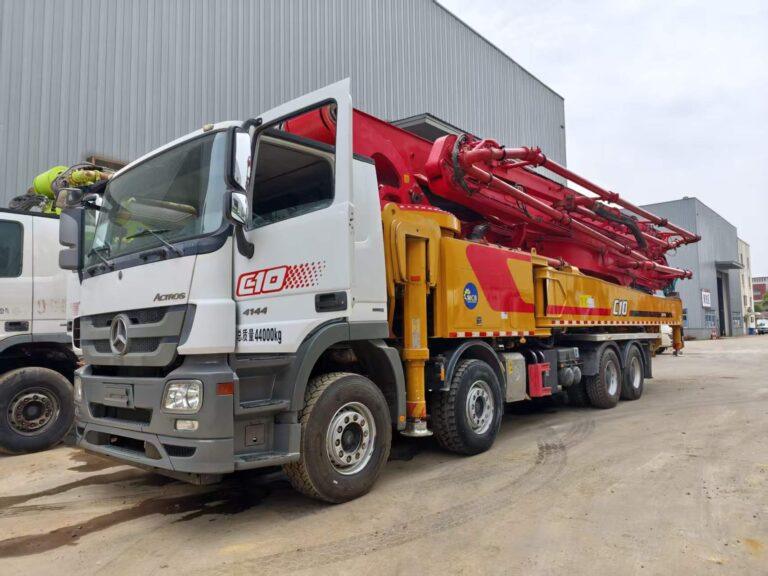
For example, this 2018 SANY 37m used concrete pump truck listing shows the kind of spec transparency buyers should expect.
If Africa is a key market for you, a shipment update like this used concrete pump truck export shipment to Egypt can also help you understand the export flow.
If you want, you can also use MechaBro to request photos/videos and a documentation package for the specific unit you’re considering.


 English
  French
  Spanish
  Arabic
  Russian
  Chinese