Building skyscrapers requires more than just height; it requires extreme vertical pressure management. When using a used concrete pump for high-rise projects, the technical demands on the hydraulic system and the S-valve are immense. At Mechabro, we specialize in providing high-pressure pump solutions that handle the world’s most challenging vertical pours. Understanding the physics of vertical pumping is key to project success and equipment longevity.

1. The Physics of Vertical Pumping: Overcoming Gravity
As concrete is pushed upward, gravity creates a massive “back pressure” on the concrete pump. This pressure increases linearly with every floor. For a 200-meter building, the static pressure of the concrete column alone can exceed 50 bar (725 psi).
•The S-Valve Challenge: The S-valve is the heart of the pump. It must seal perfectly against the wear plate to prevent concrete from flowing back into the hopper. A tiny leak at this pressure will act like a sandblaster, destroying the valve in hours.
•Hydraulic Intensity: The hydraulic pumps must maintain constant high-pressure output without overheating. This is why we perform rigorous load testing on every used SANY and Zoomlion pump destined for high-rise work.
2. Equipment Selection for Tall Buildings
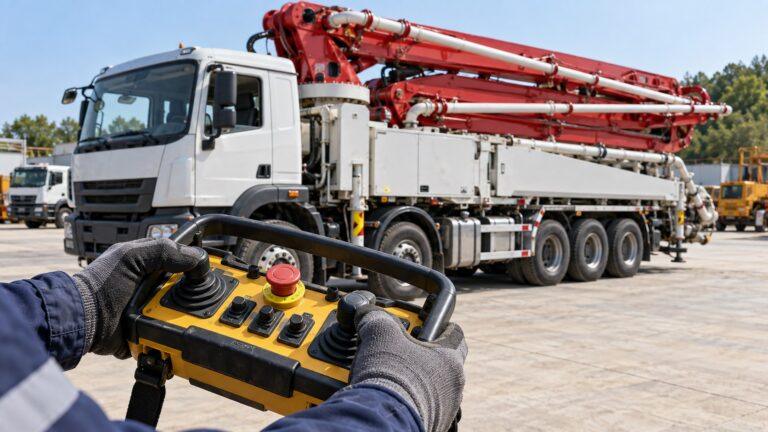
Not every used concrete pump truck is built for height. Selection must be based on the maximum theoretical pressure required at the piston.
•High-Pressure Models: Professional contractors look for models with “H” (High Pressure) designations. These machines feature reinforced hydraulic cylinders and thicker-walled delivery pipes.
•SANY’s World Records: SANY has set multiple world records for pumping height, including the iconic Burj Khalifa project. This heritage of high-pressure engineering is present in every used SANY pump we recondition.
•Safety Standards: All high-pressure operations must follow the structural and operational safety guidelines set by ASME B30.27.
3. Pipeline Fixation and Mix Design
The concrete pump is only half the equation; the delivery pipeline must be engineered for the load.
•Anchor Points: The vertical pipeline must be securely anchored to the building’s structure. Each 3-meter pipe section can weigh over 100kg when full of concrete. If not properly fixed, the vibration from the pump strokes can cause pipe fatigue and catastrophic failure.
•Mix Lubrication: High-rise concrete mixes require specialized admixtures. These reduce the internal friction between the concrete and the pipe wall. According to the American Concrete Institute (ACI), a well-designed mix can reduce pumping pressure by up to 20%, significantly extending the life of your used pump.
4. Mechabro’s High-Pressure Certification
At Mechabro, we understand that a failure at 300 meters is not an option. Our 8-step reconditioning process includes a specific “High-Pressure Validation” for skyscraper-ready units. We test the pump at its maximum rated pressure for extended periods to ensure the cooling system and hydraulic seals are up to the task. When you buy a used concrete pump from us, you are buying a machine that has been proven to conquer the skyline. For more technical data on high-rise pumping records, visit SANY Global.

 English
  French
  Spanish
  Arabic
  Russian
  Chinese